
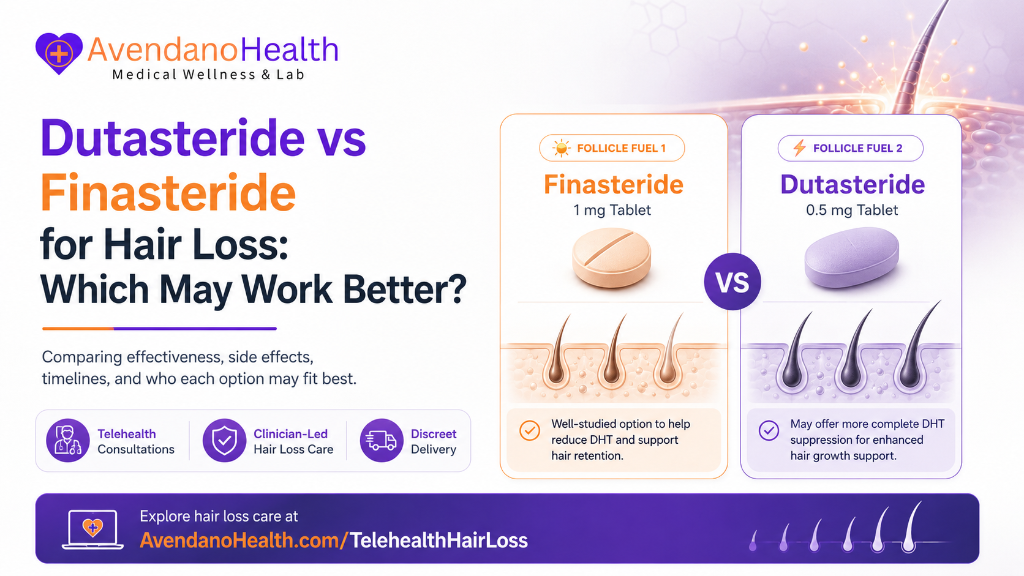
Finasteride and dutasteride are prescription medications used to slow male-pattern hair loss by reducing dihydrotestosterone, better known as DHT. DHT can gradually shrink sensitive hair follicles, causing strands to become thinner, shorter, and harder to see.
Both medications target the same hormonal pathway. However, dutasteride blocks more forms of the enzyme that produces DHT, which may make it more effective for some men. That does not mean it is automatically the best option for everyone.
Avendano Health offers provider-reviewed hair-loss options containing finasteride, dutasteride, oral minoxidil, and other ingredients. You can view our telehealth hair-loss treatments and current pricing before comparing the medications below.
Dutasteride vs finasteride at a glance
| Feature | Finasteride | Dutasteride | | ------------------------- | --------------------------------------- | ------------------------------------------------------------ | | Common hair-loss dose | 1 mg daily | 0.5 mg daily | | Enzyme activity blocked | Mainly type II 5-alpha-reductase | Type I and type II | | FDA status for hair loss | FDA-approved for male-pattern hair loss | Used off-label for hair loss | | Research history | Extensive and long-established | Strong comparative evidence, but less U.S. hair-loss history | | Typical evaluation period | Several months | Several months | | Time in the body | Shorter | Much longer | | Avendano Health formula | Follicle Fuel 1 | Follicle Fuel 2 |
How do finasteride and dutasteride work?
Your body uses an enzyme called 5-alpha-reductase to convert testosterone into DHT.
Finasteride primarily blocks the type II form of this enzyme. Dutasteride blocks both type I and type II. Because both types are present around hair follicles, dutasteride generally produces broader DHT suppression. (PubMed)
Neither medication creates brand-new follicles. Instead, treatment aims to protect follicles that are still active, slow further miniaturization, and give weaker hairs a chance to grow thicker.
Which medication appears more effective?
Several studies suggest that dutasteride 0.5 mg may produce greater average hair improvement than finasteride 1 mg.
In a randomized study of 917 men, dutasteride 0.5 mg produced significantly greater improvements in hair count, hair width, and photographic assessments after 24 weeks than finasteride 1 mg. The overall number and severity of adverse events were similar among the study groups, although the trial lasted only six months. (PubMed)
A separate randomized study of 90 men also found a larger increase in total hair count and a greater reduction in thin, miniaturized hairs with dutasteride. That study was smaller, open-label, and limited to 24 weeks. (PubMed)
A meta-analysis combining three comparative trials and 576 participants likewise favored dutasteride for hair-count and photographic outcomes over 24 weeks. However, the authors noted that more long-term research is needed. (PubMed)
The practical takeaway: dutasteride may work better on average, but finasteride remains the more established and FDA-approved hair-loss medication in the United States.
FDA approval and off-label treatment
Finasteride 1 mg is FDA-approved for treating male-pattern hair loss in adult men. Its official prescribing information states that daily treatment for at least three months is generally needed before benefit becomes noticeable. (DailyMed)
Dutasteride is FDA-approved for benign prostatic hyperplasia, or BPH—not for hair loss. A licensed clinician may still prescribe it off-label after reviewing the patient's medical history, treatment response, goals, and potential risks. (DailyMed)
"Off-label" does not mean that a drug is automatically ineffective or unsafe. It means the FDA has not specifically approved that drug for that particular condition.
How long do results take?
Hair grows slowly, so neither medication should be judged after only a few weeks.
A realistic timeline may look like this:
- Months 1–3: Consistent treatment is the priority. Some patients may notice temporary shedding.
- Months 3–6: Reduced shedding or early stabilization may become more noticeable.
- Months 6–12: Changes in density, thickness, and comparison photographs may become easier to assess.
- After 12 months: The patient and provider can better decide whether the treatment is working well enough to continue.
Finasteride labeling states that three months or more may be required before benefit is seen. Most direct dutasteride-versus-finasteride studies evaluated patients after roughly 24 weeks, so expectations should be measured in months rather than days. (DailyMed)
Taking photographs in the same room, lighting, hairstyle, and angle every month is usually more useful than checking the mirror daily.
Why might a provider start with finasteride?
Finasteride may be a reasonable starting option for a man who:
- Wants an FDA-approved male hair-loss medication
- Has not previously tried a DHT-blocking treatment
- Has mild or moderate thinning
- Prefers the medication with the longer hair-loss treatment history
- Wants an option that leaves the body more quickly after discontinuation
- Is comfortable reviewing potential side effects with a clinician
Based on Avendano Health's current listed formulas, Follicle Fuel 1 combines:
- Finasteride 1 mg
- Oral minoxidil 2.5 mg
- Biotin 1 mg
- Vitamin D3 2,000 IU
- Vitamin K2 100 mcg
Finasteride targets the DHT pathway, while minoxidil works through a different mechanism related to hair growth. A 2025 retrospective evaluation of 502 men using combined oral finasteride and low-dose oral minoxidil reported that 92.4% were stable or improved after 12 months. Because the study was retrospective and relied on photographic grading, prospective controlled trials are still needed. (PubMed)
You can review Follicle Fuel 1 and the full male hair-growth lineup on the Avendano Health hair-loss page.
When might dutasteride be considered?
A provider may discuss dutasteride when a patient:
- Has faster or more advanced male-pattern thinning
- Continued losing hair after an adequate finasteride trial
- Wants to discuss broader DHT suppression
- Understands that dutasteride is used off-label for hair loss
- Has reviewed sexual, reproductive, and prostate-screening considerations
- Accepts that the medication remains in the body much longer
Based on Avendano Health's current listed formulas, Follicle Fuel 2 combines:
- Dutasteride 0.5 mg
- Oral minoxidil 2.5 mg
- Biotin 1 mg
- Vitamin D3 2,000 IU
- Vitamin K2 100 mcg
Dutasteride's terminal half-life is approximately five weeks at steady state. Drug levels may remain detectable for four to six months after treatment is stopped, which is one reason provider screening and follow-up are important. (DailyMed)
Patients interested in stronger DHT support can compare Follicle Fuel 1 and Follicle Fuel 2 online.
What side effects should patients understand?
Both medications may cause side effects, although many patients use them without major problems.
Possible concerns include:
- Reduced libido
- Erectile difficulties
- Ejaculation changes
- Breast tenderness or enlargement
- Mood symptoms
- Fertility or semen changes
- Changes in prostate-specific antigen, or PSA, results
A systematic review of randomized trials found that 5-alpha-reductase inhibitors were associated with an increased relative risk of sexual dysfunction compared with placebo, although the absolute experience varies from person to person. The evidence base was larger for finasteride than for dutasteride. (PubMed)
Dutasteride can lower PSA substantially, so patients undergoing prostate screening should tell their clinician that they are taking it. The official dutasteride label also describes possible effects on semen characteristics and instructs patients not to donate blood until six months after their last dose. (DailyMed)
Patients should discuss sexual symptoms, mood history, fertility plans, prostate testing, liver conditions, and current medications before starting or changing treatment.
Is dutasteride always better because it is stronger?
No.
Dutasteride blocks more of the DHT-producing pathway and has outperformed finasteride in several short-term trials. However, treatment decisions are not based only on which medication is more powerful.
Finasteride may still be preferred because it:
- Is FDA-approved for male-pattern hair loss
- Has a longer treatment history
- Has a shorter time in the body
- May provide enough DHT control for the individual patient
- Allows a more conservative first treatment step
Dutasteride may be considered when the expected benefit of stronger DHT suppression outweighs its longer half-life and off-label status.
Can either medication restore a completely bald area?
Results tend to be better when follicles are miniaturized but still active.
A thinning area that still contains fine hairs may have more treatment potential than a smooth area that has been bald for many years. Medication may slow further loss and improve thickness, but it cannot guarantee full regrowth.
This is why earlier evaluation is often helpful. Waiting until follicles have been inactive for a long period may reduce the amount of recoverable hair.
Can finasteride or dutasteride be combined with minoxidil?
Yes. Clinicians may combine a DHT blocker with minoxidil because the medications target different parts of the hair-loss process.
The correct dose, route, and combination depend on medical history, blood-pressure considerations, other medications, and the provider's assessment. Patients should not combine prescription products or change doses on their own.
Avendano Health's Follicle Fuel 1 and Follicle Fuel 2 are both combination formulations containing a DHT blocker plus oral minoxidil. See the ingredients, prices, and available telehealth hair-loss options.
Important information about compounded formulations
Follicle Fuel 1 and Follicle Fuel 2 are customized combination formulations. Although finasteride itself is FDA-approved for male-pattern hair loss, the compounded combination tablets are not individually FDA-approved.
The FDA does not review compounded drugs for safety, effectiveness, or manufacturing quality before they are marketed in the same way it reviews approved medications. Compounded treatment should be prescribed only when a licensed clinician determines that it is medically appropriate for the individual patient. (U.S. Food and Drug Administration)
Dutasteride vs finasteride: which should you choose?
Finasteride may be the better starting point for men who want an FDA-approved hair-loss medication with an extensive treatment history and a shorter time in the body.
Dutasteride may be worth discussing for men with more aggressive thinning, continued loss after finasteride, or a desire to consider broader DHT suppression.
The decision should consider:
- Your pattern and stage of hair loss
- How quickly the thinning is progressing
- Previous medications and results
- Current health conditions
- Fertility plans
- Side-effect concerns
- Prostate-screening history
- Provider assessment
Frequently asked questions
Is dutasteride stronger than finasteride?
Yes, in the sense that dutasteride inhibits both type I and type II 5-alpha-reductase, while finasteride primarily inhibits type II. Clinical studies generally found greater average hair-count improvement with dutasteride 0.5 mg, but that does not make it the best choice for every patient. (PubMed)
Can I switch from finasteride to dutasteride?
A provider may consider switching after reviewing how long finasteride was taken, whether hair loss stabilized, side effects, medical history, and treatment goals. Patients should not switch or combine prescription medications without clinical guidance.
Does shedding mean the medication is failing?
Not always. A temporary change in shedding can occur as hair cycles shift. However, severe, prolonged, patchy, or unexplained hair loss should be evaluated because male-pattern hair loss is not the only cause of shedding.
Do I have to continue treatment?
Hair-loss medications generally require continued use to maintain their effect. If treatment is discontinued, DHT-driven miniaturization may gradually resume.
Is dutasteride approved for hair loss?
Not in the United States. Dutasteride is FDA-approved for BPH and may be prescribed off-label for hair loss after clinician review. (DailyMed)
Explore Avendano Health's hair-growth treatments
Avendano Health currently offers:
Follicle Fuel 1 — $149
Finasteride 1 mg, oral minoxidil 2.5 mg, biotin, vitamin D3, and vitamin K2.
Follicle Fuel 2 — $159
Dutasteride 0.5 mg, oral minoxidil 2.5 mg, biotin, vitamin D3, and vitamin K2.
ReGrow Fuel — $169
Oral minoxidil 2.5 mg, GHK-Cu, apigenin, and fisetin.
Lush Lox — $149
A female hair-growth option containing oral minoxidil 2.5 mg.
All prescription options require provider review and are prescribed only when medically appropriate. No monthly subscription is required.
Start Your Online Hair Consultation
This article is for educational purposes and does not replace medical advice, diagnosis, or treatment from a licensed healthcare professional.