
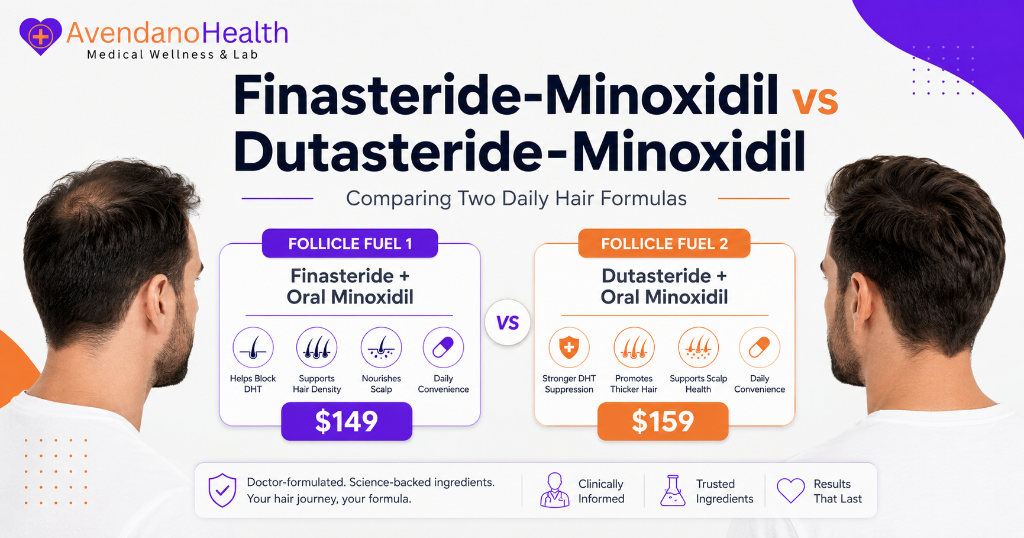
Finasteride with oral minoxidil and dutasteride with oral minoxidil both address male-pattern hair loss through two pathways:
- A 5-alpha-reductase inhibitor helps reduce DHT-driven follicle miniaturization.
- Oral minoxidil supports follicle activity and the active hair-growth phase.
The main difference is the DHT-blocking medication.
Finasteride is the more established and FDA-approved option for male-pattern hair loss. Dutasteride blocks more forms of the enzyme that creates DHT and has produced greater average hair improvement in several short-term comparative studies, but its use for hair loss is off-label in the United States.
Avendano Health currently offers both approaches:
- Follicle Fuel 1 — $149
- Follicle Fuel 2 — $159
Both are provider-reviewed daily combination tablets containing oral minoxidil 2.5 mg. The correct option depends on the patient's hair-loss pattern, previous results, health history, risk factors, and treatment goals.
Compare both male hair-growth formulas and begin the online consultation.
Quick comparison
| Feature | Follicle Fuel 1 | Follicle Fuel 2 | | ---------------------- | ------------------------------------------------------ | ------------------------------------------------------------ | | Listed price | $149 | $159 | | DHT medication | Finasteride 1 mg | Dutasteride 0.5 mg | | Oral minoxidil | 2.5 mg | 2.5 mg | | Additional ingredients | Biotin, vitamin D3, vitamin K2 | Biotin, vitamin D3, vitamin K2 | | DHT pathway | Mainly blocks type II 5-alpha-reductase | Blocks type I and type II | | U.S. hair-loss status | Finasteride is FDA-approved for male-pattern hair loss | Dutasteride is used off-label for hair loss | | Relative approach | More established starting option | Broader DHT suppression | | Time in the body | Shorter | Much longer | | May be considered for | Men beginning systemic combination treatment | Men with more aggressive loss or inadequate previous results | | Monthly subscription | Not required | Not required |
What is Follicle Fuel 1?
Follicle Fuel 1 is Avendano Health's combined daily male hair-growth tablet containing:
- Finasteride 1 mg
- Oral minoxidil 2.5 mg
- Biotin 1 mg
- Vitamin D3 2,000 IU
- Vitamin K2 100 mcg
Current listed price: $149
Finasteride helps reduce the DHT activity associated with follicle miniaturization. Oral minoxidil targets a separate growth pathway.
This formula may appeal to men who want:
- An FDA-approved DHT-blocking ingredient for male-pattern hair loss
- A more established systemic treatment pathway
- Oral minoxidil and finasteride in one tablet
- A simpler routine without topical application
- A lower listed price than Follicle Fuel 2
- No mandatory monthly subscription
Review Follicle Fuel 1 and the complete hair-growth lineup.
What is Follicle Fuel 2?
Follicle Fuel 2 is Avendano Health's advanced daily male hair-growth tablet containing:
- Dutasteride 0.5 mg
- Oral minoxidil 2.5 mg
- Biotin 1 mg
- Vitamin D3 2,000 IU
- Vitamin K2 100 mcg
Current listed price: $159
Dutasteride blocks both type I and type II 5-alpha-reductase, producing broader DHT suppression than finasteride.
This formula may be discussed when a patient:
- Has moderate or more aggressive male-pattern thinning
- Continued losing hair after an adequate finasteride trial
- Wants to discuss stronger DHT suppression
- Prefers an oral combination over topical medication
- Understands dutasteride's off-label status for hair loss
- Has completed appropriate cardiovascular, reproductive, medication, and prostate-screening review
Stronger DHT suppression does not automatically make Follicle Fuel 2 the best formula for every patient.
See Follicle Fuel 2 and compare it with the other available formulas.
How does finasteride differ from dutasteride?
The body uses 5-alpha-reductase enzymes to convert testosterone into dihydrotestosterone, commonly called DHT.
DHT can gradually shrink genetically sensitive scalp follicles. This process is called miniaturization.
Finasteride
Finasteride mainly inhibits type II 5-alpha-reductase.
It is FDA-approved at 1 mg for treating male-pattern hair loss in adult men. It has a long treatment history and is often considered before dutasteride.
Dutasteride
Dutasteride inhibits both type I and type II 5-alpha-reductase.
Because it blocks more of the pathway, it generally lowers DHT more broadly. Several clinical trials have found greater average hair-count and hair-width improvement with dutasteride 0.5 mg than finasteride 1 mg over approximately 24 weeks.
However:
- Dutasteride is not FDA-approved for hair loss in the United States.
- It stays in the body much longer.
- Stronger suppression may create different long-term considerations.
- The best medication still depends on the individual patient.
Which formula is stronger?
From a DHT-suppression standpoint, Follicle Fuel 2 is the stronger formula because it contains dutasteride.
That does not mean it contains more oral minoxidil. Both formulas contain oral minoxidil 2.5 mg.
The difference is:
- Follicle Fuel 1: finasteride 1 mg
- Follicle Fuel 2: dutasteride 0.5 mg
In a randomized study involving 917 men, dutasteride 0.5 mg produced greater average improvements in hair count, hair width, and photographic assessments than finasteride 1 mg after 24 weeks.
A smaller randomized study also favored dutasteride for total hair count and reversal of follicle miniaturization.
Those studies compared dutasteride and finasteride as medications. They did not directly compare the exact Follicle Fuel 1 and Follicle Fuel 2 compounded tablets.
Which formula has better evidence?
The answer depends on what type of evidence is being considered.
Finasteride has the more established regulatory and treatment history
Finasteride 1 mg:
- Is FDA-approved for male-pattern hair loss
- Has been studied for decades
- Has established prescribing information
- Has direct evidence supporting its use with minoxidil
- Has direct real-world evidence for a 1 mg finasteride and 2.5 mg oral-minoxidil combination
A 2025 retrospective evaluation followed 502 men using oral finasteride 1 mg with oral minoxidil 2.5 mg. After 12 months, 92.4% were rated stable or improved, and 57.4% showed improvement rather than stability alone.
That study used the same core prescription doses found in Follicle Fuel 1.
However, the study:
- Was retrospective
- Did not include a placebo group
- Did not directly compare the formula with dutasteride
- Used photographic ratings with limited reviewer agreement
- Cannot guarantee that an individual patient will respond
Dutasteride has stronger short-term medication-comparison results
Multiple studies comparing dutasteride with finasteride have generally favored dutasteride for average hair outcomes.
This provides a reasonable clinical basis for considering dutasteride when stronger DHT suppression is desired.
However, there is less direct evidence for the exact dutasteride 0.5 mg and oral minoxidil 2.5 mg compounded combination.
Research comparing oral-minoxidil monotherapy with combination treatment involving finasteride or dutasteride is emerging, but additional prospective trials are needed.
Practical evidence summary
Follicle Fuel 1 has the clearer direct evidence for its exact core oral combination.
Follicle Fuel 2 uses the DHT blocker that has generally performed better in direct dutasteride-versus-finasteride trials.
These are different strengths of evidence and should not be treated as the same claim.
Why do both formulas contain oral minoxidil?
Finasteride and dutasteride primarily address DHT-driven miniaturization.
Oral minoxidil supports a different part of the hair-growth process.
Its exact mechanism is not fully understood, but it may:
- Support the active growth phase
- Improve hair-shaft diameter
- Help miniaturized follicles produce more visible strands
- Improve density in responsive patients
Combining oral minoxidil with a DHT-blocking medication creates a two-pathway strategy:
- Help reduce continued hormonal follicle damage
- Support growth activity in follicles that remain alive
Oral minoxidil is used off-label for hair loss and has systemic effects. Provider screening remains important even at doses described as low-dose oral minoxidil.
Is one formula more convenient?
Both formulas provide the same basic convenience advantage: several ingredients in one daily tablet.
A combined tablet may reduce:
- Separate medication bottles
- Topical application
- Drying time
- Greasy or stiff hair
- Scalp residue
- Interference with styling
- The number of daily treatment steps
A simpler routine may make consistency easier.
However, combining ingredients also creates a tradeoff.
If a patient develops a side effect, the provider cannot always remove or adjust one ingredient without changing the entire compounded formula.
The provider may need to:
- Stop the full tablet
- Prescribe the ingredients separately
- Change the dose
- Select a topical option
- Choose another formula
Patients should not cut, crush, double, or alter a compounded medication unless directed by the prescriber or pharmacist.
Which formula may be better for someone starting treatment?
Follicle Fuel 1 may be the more natural option to discuss when the patient:
- Has not previously used a prescription DHT blocker
- Wants the FDA-approved hair-loss ingredient
- Has early or moderate male-pattern thinning
- Prefers a more established first systemic step
- Wants the medication that leaves the body faster
- Does not have a clear reason to begin with broader DHT suppression
This does not mean every new patient will qualify for Follicle Fuel 1.
Medical history, blood pressure, medications, fertility plans, symptoms, and other causes of hair loss must still be reviewed.
When might Follicle Fuel 2 be considered?
Follicle Fuel 2 may be discussed when the patient:
- Has faster or more advanced thinning
- Continued losing hair after a consistent finasteride trial
- Did not achieve adequate stabilization
- Has used treatment long enough for a fair evaluation
- Wants to discuss broader DHT suppression
- Understands dutasteride's long half-life
- Accepts that dutasteride is used off-label for hair loss
- Has no major contraindication identified during screening
A patient should not move to a stronger treatment simply because visible regrowth did not appear after one or two months.
Most hair-loss treatment must be evaluated over six to twelve months.
Side-effect comparison
Both formulas contain oral minoxidil, so they share oral-minoxidil considerations.
The primary difference is the risk profile of finasteride compared with dutasteride.
Possible effects associated with finasteride or dutasteride
- Reduced libido
- Erectile difficulties
- Ejaculation changes
- Reduced semen volume
- Fertility concerns
- Breast tenderness or enlargement
- Mood symptoms
- Allergic reactions
- Changes in PSA interpretation
Dutasteride generally lowers DHT more broadly and remains in the body much longer.
Its terminal half-life is approximately five weeks after steady use. Measurable levels may remain for months after treatment is discontinued.
Possible oral-minoxidil effects
- Increased facial or body hair
- Temporary scalp shedding
- Lightheadedness
- Headache
- Faster heartbeat
- Palpitations
- Ankle or facial swelling
- Fluid retention
- Lower blood pressure
Hair-loss specialists have developed consensus guidance addressing low-dose oral-minoxidil contraindications, precautions, baseline evaluation, monitoring, and situations that may require specialist input.
Patients should seek prompt medical attention for symptoms such as:
- Chest pain
- Fainting
- Severe shortness of breath
- Rapid or irregular heartbeat
- Significant swelling
- Sudden unexplained weight gain
- Severe allergic symptoms
Medical screening before either formula
Because both formulas contain systemic prescription medications, the consultation should review more than the patient's hairline.
A provider may ask about:
- Blood pressure
- Resting heart rate
- Dizziness or fainting
- Heart rhythm problems
- Chest pain
- Fluid retention
- Leg swelling
- Kidney or liver conditions
- Current medications
- Other minoxidil products
- Other DHT-blocking medications
- Sexual symptoms
- Fertility plans
- Mood history
- Prostate screening
- PSA results
- Other possible causes of hair loss
The provider may also need to determine whether the hair-loss pattern is truly androgenetic alopecia.
Sudden, patchy, painful, heavily inflamed, or scarring hair loss may require a different evaluation.
Results timeline for both formulas
Both formulas should be judged over months rather than days.
Month 1
Possible experiences include:
- No visible change
- Continued baseline shedding
- Temporary minoxidil-related shedding
- Early side effects
- Anxiety from checking too frequently
Month 3
A patient may begin noticing:
- Reduced daily shedding
- Early stabilization
- Fine new growth
- Slight improvement in coverage
- No obvious change yet
Finasteride labeling notes that three months or more may be necessary before benefit becomes noticeable.
Month 6
This is the first meaningful results checkpoint.
Patients may see:
- Better hair retention
- Improved crown density
- Thicker-looking strands
- Reduced scalp visibility
- Stabilization without major regrowth
- Limited response despite consistent use
Month 12
A full year provides a more reliable comparison.
The patient and provider can assess:
- Whether thinning slowed
- Whether density improved
- Changes in standardized photographs
- Whether side effects remain acceptable
- Whether the current formula should continue
- Whether a different approach should be considered
A progressive condition may still be responding when treatment preserves existing hair without dramatic regrowth.
Does Follicle Fuel 2 work faster?
Not necessarily.
Dutasteride provides broader DHT suppression, but hair follicles still require time to complete new growth cycles.
Neither formula should be expected to create immediate visible regrowth.
Both should generally be evaluated through:
- Consistent treatment
- Standardized photographs
- Changes in shedding
- Hair density
- Hair-shaft thickness
- Tolerability
- Provider follow-up
Is the $10 difference the main decision?
No.
The current listed prices are:
- Follicle Fuel 1: $149
- Follicle Fuel 2: $159
The $10 difference is small compared with the medical differences between finasteride and dutasteride.
The decision should focus on:
- Previous treatment history
- Stage of hair loss
- Rate of progression
- Medical risks
- Side-effect concerns
- Fertility plans
- PSA and prostate considerations
- Comfort with off-label treatment
- Provider recommendation
Price can be considered, but it should not replace medical judgment.
Questions to ask the provider
Before choosing a formula, consider asking:
- Does my hair-loss pattern appear consistent with androgenetic alopecia?
- Should I begin with finasteride before considering dutasteride?
- Have I completed an adequate trial of my previous treatment?
- Does my blood pressure or cardiac history affect oral-minoxidil eligibility?
- Could another medical issue be contributing to my shedding?
- How might treatment affect sexual function or fertility?
- Should my PSA results be interpreted differently?
- What side effects require stopping treatment or seeking urgent care?
- When should photographs and progress be reviewed?
- What happens if I tolerate one ingredient but not the other?
- Would separate medications be more appropriate than a combined tablet?
- What result would count as a successful response for my stage of hair loss?
How to choose between Follicle Fuel 1 and Follicle Fuel 2
Follicle Fuel 1 may be worth discussing when:
- You are starting systemic combination treatment
- You want finasteride, the FDA-approved male hair-loss ingredient
- You prefer the more established treatment history
- Your hair loss is early or moderate
- You do not have a clear need for broader DHT suppression
Follicle Fuel 2 may be worth discussing when:
- You have more aggressive or advanced thinning
- Finasteride did not provide adequate stabilization
- You completed a fair previous treatment trial
- You want to discuss stronger DHT suppression
- You understand dutasteride's off-label status and longer half-life
Neither formula may be appropriate when:
- Oral minoxidil creates unacceptable cardiovascular risk
- The diagnosis is unclear
- Hair loss is sudden or patchy
- A scarring or inflammatory condition is suspected
- The patient cannot safely use a 5-alpha-reductase inhibitor
- The provider identifies another contraindication
Are these formulas FDA-approved?
No.
Finasteride 1 mg is FDA-approved for male-pattern hair loss.
Dutasteride is FDA-approved for benign prostatic hyperplasia, not hair loss.
Oral minoxidil is FDA-approved for severe hypertension, not hair loss.
Follicle Fuel 1 and Follicle Fuel 2 are customized compounded formulations and are not individually FDA-approved.
The FDA does not review compounded drugs for safety, effectiveness, or quality before they are marketed in the same way it reviews FDA-approved medications.
Compounded treatment should be prescribed only when a licensed clinician determines it is medically appropriate for the individual patient.
Frequently asked questions
Is dutasteride-minoxidil stronger than finasteride-minoxidil?
It provides broader DHT suppression because dutasteride blocks both type I and type II 5-alpha-reductase. Both Avendano Health formulas contain the same listed oral-minoxidil dose.
Does stronger mean better?
No. Stronger DHT suppression may be useful for selected patients, but it also comes with off-label status, a longer half-life, and different medical considerations.
Which formula has more direct combination evidence?
The finasteride 1 mg and oral minoxidil 2.5 mg combination has direct 12-month retrospective evidence involving 502 men. Direct evidence for the exact dutasteride and oral-minoxidil combination is more limited.
Which one is FDA-approved?
Neither compounded formula is FDA-approved. Finasteride 1 mg, as an individual medication, is FDA-approved for male-pattern hair loss.
Can I switch from Follicle Fuel 1 to Follicle Fuel 2?
A provider may consider a switch after reviewing treatment duration, adherence, results, side effects, health history, and goals. Patients should not switch or combine prescription formulas without guidance.
Can the formulas be taken together?
No patient should combine the two formulas unless specifically directed by a licensed clinician. Doing so could duplicate oral minoxidil and expose the patient to both finasteride and dutasteride.
Which formula works faster?
There is no reliable guarantee that one formula will produce visible results faster. Both generally require several months.
Do I need to experience shedding for treatment to work?
No. Temporary shedding can occur, particularly from minoxidil, but it is not required for treatment success.
Is there a monthly subscription?
No monthly subscription is required for the listed Avendano Health hair-growth options.
Is prescription approval guaranteed?
No. A licensed provider reviews the patient's medical information and determines whether treatment is appropriate.
Compare Avendano Health's male hair formulas
Follicle Fuel 1 — $149
- Finasteride 1 mg
- Oral minoxidil 2.5 mg
- Biotin 1 mg
- Vitamin D3 2,000 IU
- Vitamin K2 100 mcg
Follicle Fuel 2 — $159
- Dutasteride 0.5 mg
- Oral minoxidil 2.5 mg
- Biotin 1 mg
- Vitamin D3 2,000 IU
- Vitamin K2 100 mcg
Both are designed as once-daily, provider-supervised male hair-growth formulas.
All prescription treatment requires medical review, and approval is not guaranteed.
Compare the Formulas and Start Your Hair Consultation
This article is educational and does not replace medical advice, diagnosis, or treatment from a licensed healthcare professional.
References
-
Harcha WG, et al. Randomized comparison of dutasteride, finasteride, and placebo in male androgenetic alopecia. Journal of the American Academy of Dermatology. PMID: 24411083.
-
Gupta AK, et al. Superiority of dutasteride over finasteride in hair regrowth and reversal of miniaturization. PMID: 27549867.
-
Zhou Z, et al. Dutasteride compared with finasteride for androgenetic alopecia: systematic review and meta-analysis. PMID: 30863034.
-
Johnson H, et al. Effectiveness of combined oral minoxidil and finasteride in male androgenetic alopecia. PMID: 39958004.
-
Nohria A, et al. Low-dose oral minoxidil monotherapy compared with combination therapy involving dutasteride or finasteride. PMID: 39894359.
-
Akiska YM, et al. International consensus statement on low-dose oral minoxidil initiation for hair loss. PMID: 39565602.
-
Current finasteride, dutasteride, and oral-minoxidil prescribing information. DailyMed.
-
U.S. Food and Drug Administration. Understanding the Risks of Compounded Drugs.