
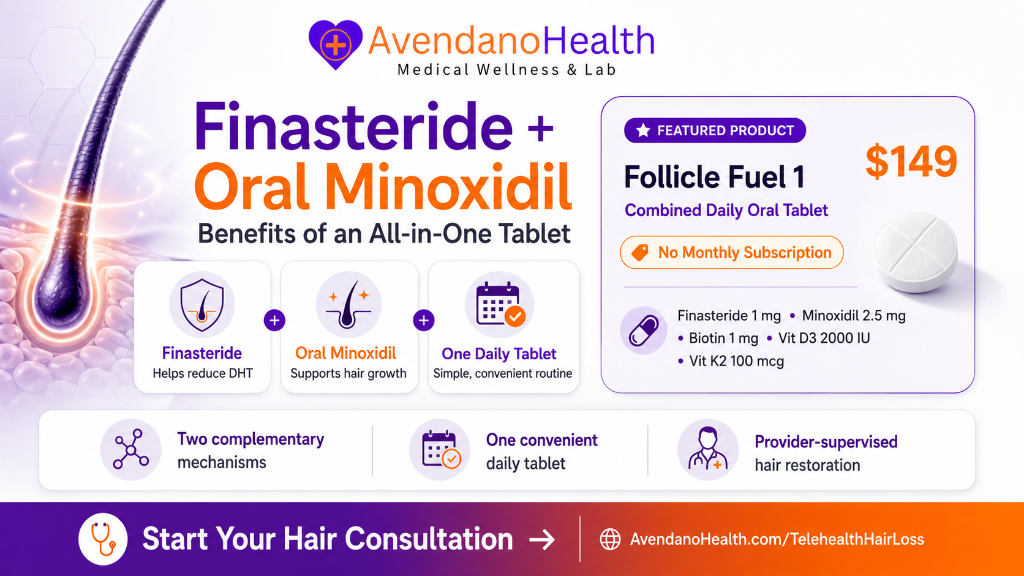
Male-pattern hair loss usually involves more than one biological process. Dihydrotestosterone, or DHT, can gradually shrink genetically sensitive follicles, while shortened growth cycles can prevent those follicles from producing long, thick strands.
Finasteride and oral minoxidil approach these problems differently:
- Finasteride helps reduce DHT-driven follicle miniaturization.
- Minoxidil helps support the follicle's active growth phase.
Because they target separate parts of the hair-loss process, clinicians may prescribe them together for selected patients.
Avendano Health's Follicle Fuel 1 combines finasteride 1 mg and oral minoxidil 2.5 mg with biotin, vitamin D3, and vitamin K2 in one provider-selected daily tablet.
You can view Follicle Fuel 1, its ingredients, and current pricing before reviewing how the combination works.
Finasteride and oral minoxidil at a glance
| Feature | Finasteride | Oral minoxidil | | --------------------------- | ----------------------------------------------- | --------------------------------------------------------- | | Main role | Reduces DHT activity | Supports follicle growth activity | | Hair-loss status | FDA-approved for male-pattern hair loss at 1 mg | Used off-label for hair loss | | Primary target | DHT-driven follicle miniaturization | Hair-growth cycle and follicle stimulation | | Common early experience | Usually gradual stabilization | Temporary shedding may occur | | Common concerns | Sexual or mood-related effects | Unwanted hair growth, dizziness, swelling, fast heartbeat | | Included in Follicle Fuel 1 | 1 mg | 2.5 mg |
Why are finasteride and minoxidil combined?
Finasteride and minoxidil do not perform the same job.
Finasteride addresses one of the major hormonal causes of male-pattern hair loss. Minoxidil supports the growth activity of follicles that may already be becoming weaker.
Using both may provide a broader strategy than relying on only one pathway:
- Help protect follicles from continued DHT exposure
- Support longer or more productive hair-growth cycles
- Improve the chance of maintaining existing hair
- Potentially support thicker-looking growth over time
Combination therapy does not guarantee regrowth, and results vary. However, targeting both follicle protection and growth stimulation is a common clinical approach for androgenetic alopecia.
How does finasteride work?
Your body uses an enzyme called 5-alpha-reductase to convert testosterone into DHT.
In men with genetically sensitive follicles, DHT can gradually cause those follicles to shrink. Each new strand may become:
- Shorter
- Finer
- Lighter
- Less visible
- More likely to stop growing over time
Finasteride mainly inhibits the type II form of 5-alpha-reductase. Lowering DHT can help slow this miniaturization process.
Finasteride 1 mg is FDA-approved for male-pattern hair loss in adult men. Daily use for at least three months is generally needed before benefit becomes noticeable, and continued treatment is usually required to maintain the effect.[1]
Finasteride does not instantly create new follicles. Its main value is helping protect follicles that remain active.
How does oral minoxidil work?
Minoxidil was originally developed as a blood-pressure medication. Its use for hair loss at lower oral doses is off-label.
The exact hair-growth mechanism is not completely understood. Minoxidil appears to support follicle activity and may help extend the anagen, or active growth, phase of the hair cycle.
Potential benefits may include:
- Supporting thicker hair shafts
- Helping miniaturized follicles produce more visible strands
- Extending the active growth period
- Improving scalp coverage in responsive patients
Because oral minoxidil circulates throughout the body, it does not require daily scalp application. That can make it more convenient for patients who dislike topical residue, styling disruption, or twice-daily application.
However, oral minoxidil also has systemic effects. Provider screening is important because it can influence blood pressure, heart rate, and fluid retention.[2]
Why might one daily tablet be easier?
Hair-loss treatment only has a chance to work when it is used consistently.
A routine involving several separate medications may become difficult because patients must remember:
- Multiple bottles
- Different dosing schedules
- Topical applications
- Drying time
- Scalp residue
- Refills from different sources
An all-in-one tablet may simplify that routine.
Possible convenience benefits include:
- One tablet instead of separate medications
- One daily schedule
- No liquid application
- No waiting for the scalp to dry
- Less interference with hairstyling
- Easier travel
- Fewer treatment steps to remember
Convenience does not guarantee adherence, and a combined tablet prevents the patient from adjusting one ingredient independently. That is why the dose and formulation must be selected by a licensed provider.
Patients looking for a simplified routine can review Avendano Health's combined hair-growth options.
What does the research say about the oral combination?
A 2025 retrospective evaluation reviewed 502 men treated with a combined tablet containing oral finasteride 1 mg and oral minoxidil 2.5 mg.
After 12 months:
- 92.4% were rated as stable or improved
- 57.4% showed improvement rather than stability alone
The results are encouraging, particularly because the medication doses match the core prescription ingredients in Follicle Fuel 1.[3]
However, the research has important limitations:
- It was retrospective, not a randomized controlled trial
- It did not include a placebo or single-medication comparison group
- Photographic ratings had limited agreement between reviewers
- It could not determine how much improvement came from each ingredient
- Patients who did not have complete follow-up photographs were excluded
The study supports the potential of the combination but does not prove that every patient will improve or that the oral combination is superior to all alternatives.
Does combination therapy work better than either medication alone?
Older randomized evidence using oral finasteride plus topical minoxidil found that the combination produced better results than either medication alone.
In a 12-month randomized study involving men with androgenetic alopecia:
- 80.5% improved with finasteride
- 59% improved with topical minoxidil
- 94.1% improved with the combination
That trial used topical—not oral—minoxidil, so it should not be treated as direct proof of Follicle Fuel 1. It does, however, support the general strategy of combining a DHT blocker with a separate minoxidil pathway.[4]
What is Follicle Fuel 1?
Follicle Fuel 1 is Avendano Health's combined daily male hair-growth tablet.
The current formulation includes:
- Finasteride 1 mg
- Oral minoxidil 2.5 mg
- Biotin 1 mg
- Vitamin D3 2,000 IU
- Vitamin K2 100 mcg
Current listed price: $149
The formula is designed to provide DHT support, hair-growth stimulation, and nutritional ingredients through one once-daily routine.
Biotin and vitamins do not replace testing or treatment for a true nutritional deficiency. They also do not independently overcome DHT-driven male-pattern hair loss.
Follicle Fuel 1 requires provider review and is prescribed only when medically appropriate. No monthly subscription is required.
See Follicle Fuel 1 and start the online hair consultation.
Who may be considered for the combination?
A provider may consider a finasteride and oral minoxidil combination for an adult man who:
- Has a pattern consistent with androgenetic alopecia
- Has gradual thinning at the crown, top, or frontal scalp
- Wants to address both DHT and follicle growth
- Prefers a tablet over topical medication
- Can use treatment consistently
- Understands the potential risks
- Has no clear contraindication identified during screening
- Accepts that visible results may take six to twelve months
The combination may not be appropriate for everyone.
A clinician may need to review:
- Blood pressure
- Resting pulse
- Cardiovascular history
- Kidney or liver conditions
- Current medications
- Sexual or fertility concerns
- Mood history
- Prostate and PSA screening
- Other potential causes of hair loss
Sudden, patchy, painful, or heavily inflamed hair loss may require a different evaluation.
How long do results take?
Hair grows slowly. Patients should not expect a dramatic change after several days or weeks.
Months 1–3
The treatment is becoming established.
A patient may notice:
- No visible change
- Continued baseline shedding
- Temporary increased shedding
- Early reduction in hair fall
- Side effects, if they occur
Temporary shedding is more commonly associated with the minoxidil component as follicles transition into a new cycle.
Months 3–6
Early stabilization may become easier to recognize.
Possible changes include:
- Less hair in the shower
- Reduced daily shedding
- Fine new hairs
- Slightly thicker-looking coverage
- No obvious visible change yet
Finasteride labeling notes that three months or more may be required before benefit becomes noticeable.[1]
Months 6–12
This is the more meaningful evaluation period.
Patients may begin seeing:
- Better crown coverage
- Thicker-looking strands
- Reduced scalp visibility
- Stabilization of recession
- Improvement in standardized photographs
- Continued thinning despite treatment
The 502-patient oral-combination evaluation measured outcomes after 12 months, not after only a few weeks.[3]
Can the combination cause early shedding?
Yes, temporary shedding may occur.
Minoxidil can shift follicles from a resting phase into a new active cycle. Older strands may fall before replacement growth becomes visible.
This is sometimes called the "dread shed."
It does not happen to everyone, and it does not automatically mean treatment is failing.
Patients should contact the provider when shedding is:
- Severe
- Patchy
- Painful
- Associated with redness or scarring
- Continuing without improvement
- Accompanied by other symptoms
- Causing rapidly visible loss
Male-pattern hair loss is not the only cause of shedding. Thyroid conditions, iron deficiency, severe stress, illness, weight loss, medications, and nutritional deficiencies may also contribute.
Possible finasteride side effects
Potential finasteride-related effects include:
- Reduced libido
- Erectile difficulties
- Ejaculation changes
- Reduced semen volume
- Breast tenderness or enlargement
- Mood changes
- Fertility concerns
- Changes in PSA interpretation
The current finasteride label lists decreased libido, erectile dysfunction, and ejaculation disorder among the most commonly reported adverse reactions occurring more often than with placebo.[1]
Patients should tell their provider about sexual symptoms, depression or mood history, fertility plans, prostate screening, and other medications.
Women who are pregnant or could become pregnant should not handle crushed or broken finasteride tablets because of potential risk to a developing male fetus.
Possible oral-minoxidil side effects
Potential oral-minoxidil effects include:
- Increased facial or body hair
- Lightheadedness
- Faster heartbeat
- Headache
- Ankle or facial swelling
- Fluid retention
- Lower blood pressure
- Temporary scalp shedding
Although hair-loss clinicians use much lower doses than those historically prescribed for severe hypertension, oral minoxidil still has systemic activity.
The FDA-approved oral-minoxidil label carries a boxed warning involving serious cardiovascular risks at its approved hypertension use. Low-dose hair-loss prescribing is off-label and requires thoughtful patient selection and monitoring.[2]
Patients should seek urgent medical care for symptoms such as:
- Chest pain
- Fainting
- Severe shortness of breath
- Rapid or irregular heartbeat
- Significant swelling
- Sudden unexplained weight gain
Can one ingredient be stopped while continuing the other?
Not easily when both medications are compounded into one tablet.
That is one tradeoff of an all-in-one formulation.
If a patient develops a suspected side effect, the provider may need to:
- Stop the entire tablet
- Change to separate medications
- Reduce or reformulate the dose
- Choose a different treatment strategy
Patients should not cut, double, or modify a compounded tablet unless specifically instructed by the prescriber or pharmacist.
Is Follicle Fuel 1 FDA-approved?
Finasteride 1 mg is FDA-approved for male-pattern hair loss.
Oral minoxidil is FDA-approved as a medication for severe hypertension. Its low-dose use for hair loss is off-label.
Follicle Fuel 1 is a customized compounded combination and is not individually FDA-approved.
The FDA does not review compounded medications for safety, effectiveness, or quality before they are marketed in the same way it reviews approved drug products. Compounded medications may serve a medical need for certain patients, but they require appropriate prescribing and pharmacy oversight.[5]
Is the combination better than topical treatment?
It depends on the patient.
An oral combination may be attractive for someone who:
- Dislikes topical residue
- Has difficulty applying medication consistently
- Wants one daily routine
- Experiences scalp irritation from topical products
- Has hair or styling practices that make application difficult
Topical treatment may be preferred by someone who:
- Wants to avoid systemic minoxidil exposure
- Has cardiovascular concerns
- Wants the ability to adjust medications separately
- Prefers an FDA-approved topical minoxidil product
- Is not medically eligible for oral minoxidil
The most convenient option is not automatically the safest or most appropriate option.
How should progress be measured?
Checking the mirror every day can make progress difficult to judge.
Patients should take standardized photographs at:
- Baseline
- Month 1
- Month 3
- Month 6
- Month 9
- Month 12
Use the same:
- Lighting
- Room
- Hairstyle
- Hair length
- Camera angle
- Distance
- Wet or dry condition
Photograph the front, temples, top, and crown.
Treatment success may involve regrowth, but slowing continued loss can also be meaningful in a progressive condition.
Frequently asked questions
Can finasteride and oral minoxidil be taken together?
Yes, clinicians may prescribe them together because they target different aspects of male-pattern hair loss. Medical screening is required because each medication has its own risks and contraindications.
Is Follicle Fuel 1 taken once daily?
Based on the current Avendano Health offering, Follicle Fuel 1 is designed as one combined daily tablet. Patients must follow the exact instructions provided by the prescribing clinician and pharmacy.
Does oral minoxidil replace finasteride?
No. Oral minoxidil does not directly replace finasteride's DHT-blocking role. The medications target different pathways.
Does finasteride replace minoxidil?
Not necessarily. Finasteride may slow DHT-driven miniaturization, while minoxidil may provide additional growth stimulation.
Is an all-in-one pill more effective?
The combination may provide broader pathway coverage, and retrospective evidence is encouraging. However, no strong randomized trial has established that the all-oral compounded tablet is superior for every patient.
When should results be judged?
Early tolerance can be reviewed within the first one to three months. Visible effectiveness is more meaningfully assessed around months six and twelve.
Will the combination regrow a completely bald area?
Results are generally better where miniaturized follicles remain. A smooth area that has been bald for many years is less likely to experience substantial medication-driven regrowth.
Do results last after stopping treatment?
Hair-loss medications usually need continued use to maintain their effects. Finasteride labeling states that withdrawal can lead to reversal of benefit within approximately 12 months.[1]
Is there a monthly subscription?
No monthly subscription is required for Avendano Health's listed hair-growth options.
Explore Follicle Fuel 1
Follicle Fuel 1 combines:
- Finasteride 1 mg
- Oral minoxidil 2.5 mg
- Biotin 1 mg
- Vitamin D3 2,000 IU
- Vitamin K2 100 mcg
It is designed for men seeking DHT support and hair-growth stimulation through one provider-supervised daily routine.
All prescription treatment requires medical review, and approval is not guaranteed.
Start Your Online Hair Consultation
This article is educational and does not replace medical advice, diagnosis, or treatment from a licensed healthcare professional.
References
-
Finasteride tablets, 1 mg. Current U.S. prescribing information. DailyMed.
-
Minoxidil tablets. Current U.S. prescribing information and international expert consensus on low-dose oral minoxidil.
-
Johnson H, et al. Effectiveness of combined oral minoxidil and finasteride in male androgenetic alopecia: a retrospective service evaluation. 2025. PMID: 39958004.
-
Combined finasteride and topical minoxidil treatment in male androgenetic alopecia: randomized comparative study. PMID: 26031764.
-
U.S. Food and Drug Administration. Consumer and healthcare professional information about compounded drugs.