
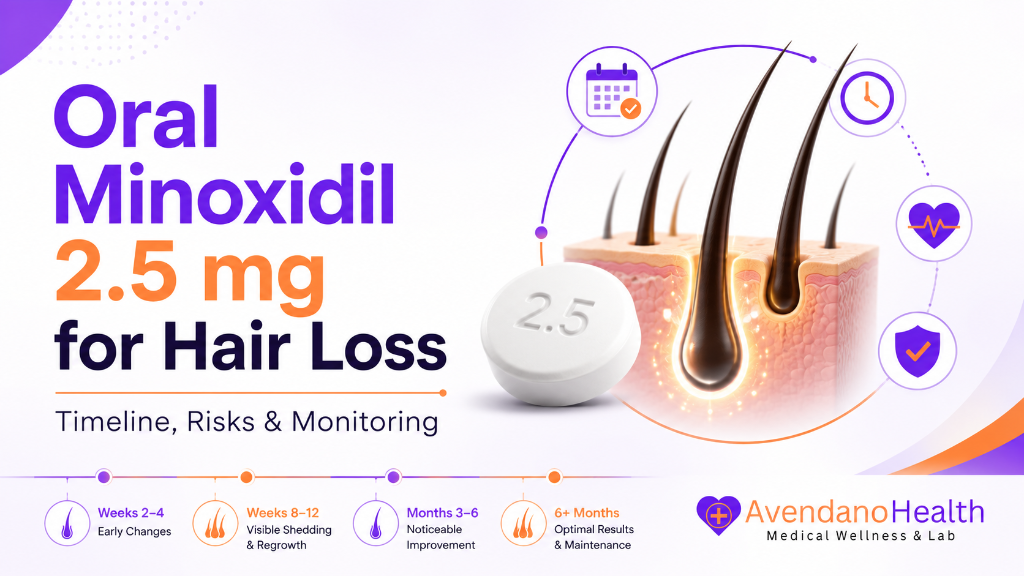
Oral minoxidil 2.5 mg is increasingly prescribed off-label for male and female hair loss. It offers a convenient alternative for patients who dislike topical liquid, scalp residue, drying time, or repeated daily application.
However, oral minoxidil is not simply topical minoxidil in pill form.
Because the medication circulates throughout the body, it may affect:
- Hair follicles across the scalp
- Facial and body hair
- Blood pressure
- Heart rate
- Fluid balance
Visible hair improvement also takes time. Some patients notice temporary shedding before new growth becomes apparent, while others do not see a meaningful difference until months four through six.
Avendano Health currently offers oral minoxidil 2.5 mg in four provider-reviewed hair formulas for men and women.
Review all four telehealth hair-loss options, ingredients, and current pricing.
Oral minoxidil 2.5 mg at a glance
| Question | Key point | | --------------------------------- | ---------------------------------------------------------------------------- | | Is it FDA-approved for hair loss? | No. Oral minoxidil is prescribed off-label for hair loss | | Is 2.5 mg considered low dose? | It falls within commonly studied low-dose hair-loss ranges | | When may results begin? | Early changes may appear after three to six months | | When should results be judged? | Usually around six to twelve months | | Can initial shedding occur? | Yes, but not everyone experiences it | | Most common visible side effect | Increased facial or body hair | | Can it affect blood pressure? | Yes. It is a systemic vasodilator | | Is medical screening necessary? | Yes, especially for cardiovascular, kidney, medication, and swelling history | | Avendano Health options | Follicle Fuel 1, Follicle Fuel 2, ReGrow Fuel, and Lush Lox |
What is oral minoxidil?
Minoxidil was originally developed as an oral medication for severe high blood pressure.
Topical minoxidil was later developed for hair loss after clinicians observed that oral minoxidil could increase hair growth.
Today, some clinicians prescribe much lower oral doses for:
- Male-pattern hair loss
- Female-pattern hair loss
- Telogen effluvium
- Other selected nonscarring hair-loss conditions
This use is off-label.
Off-label does not automatically mean unsafe or ineffective. It means the FDA has not approved oral minoxidil specifically for hair loss.
The 2025 international expert consensus on low-dose oral minoxidil acknowledged growing clinical use while also emphasizing that larger trials, standardized guidance, and better long-term safety data are still needed.[1]
How does oral minoxidil support hair growth?
The exact mechanism is not fully understood.
Minoxidil is converted into an active form called minoxidil sulfate. Its proposed hair-related effects include:
- Supporting the active anagen growth phase
- Shortening the resting phase before new growth begins
- Increasing hair-shaft diameter
- Supporting activity around miniaturized follicles
- Improving visible density in responsive patients
Oral minoxidil does not directly block DHT.
That is why it may be combined with finasteride or dutasteride in male-pattern hair-loss plans. Minoxidil supports growth activity, while the DHT-blocking medication addresses hormonal follicle miniaturization.
Compare Avendano Health's oral-minoxidil formulas.
Oral minoxidil 2.5 mg hair-loss timeline
The timeline varies by diagnosis, genetics, sex, dose, age, treatment consistency, and the condition of the remaining follicles.
A practical timeline may look like this.
Month 1: Usually no visible regrowth yet
During the first few weeks, most patients should not expect a major visual change.
Possible early experiences include:
- No noticeable difference
- Continued baseline hair loss
- Temporary increased shedding
- Lightheadedness
- Headache
- Mild swelling
- Faster heartbeat
- Increased facial or body hair beginning to appear
The medication may already be affecting follicle activity, but hair must move through a slow biological cycle before visible improvement reaches the scalp surface.
This is also when early tolerability matters most.
Patients should report new cardiovascular symptoms rather than waiting for a routine follow-up.
Months 1–3: Temporary shedding may occur
Minoxidil can shift follicles out of a resting phase and into a new growth cycle.
When that happens, older resting hairs may fall before replacement hairs become visible. Patients often call this the "minoxidil shed" or "dread shed."
Temporary shedding:
- Does not affect every patient
- Is not required for treatment to work
- Does not automatically mean hair loss is worsening
- Should generally improve rather than continue indefinitely
A study examining low-dose oral-minoxidil initiation reported temporary shedding in a minority of patients. The researchers found that approximately 5% experienced this early shedding pattern.[2]
Severe, patchy, painful, inflamed, or prolonged shedding should not automatically be blamed on minoxidil.
Other possible causes include:
- Iron deficiency
- Thyroid disease
- Major illness
- Rapid weight loss
- Severe stress
- Medication changes
- Autoimmune hair loss
- Inflammatory scalp disease
- Hormonal changes
- Nutritional deficiencies
Month 3: Early stabilization may become noticeable
At approximately three months, some patients begin noticing:
- Less hair falling in the shower
- Reduced shedding during brushing
- Fine new hairs
- Slight improvement in scalp coverage
- Early thickening
- No obvious visible difference yet
No clear change at month three does not necessarily mean the treatment has failed.
Hair-loss specialists generally evaluate oral minoxidil over a longer period. Recent expert guidance suggests that meaningful clinical response may be expected around months four through six.[3]
Progress should be measured with standardized photographs rather than memory alone.
Months 4–6: The first meaningful results checkpoint
This is when treatment response may become easier to recognize.
Possible changes include:
- Reduced scalp visibility
- Improved crown coverage
- Thicker-looking strands
- More visible fine hairs
- Reduced daily shedding
- Improved photographic density
- Stabilization without dramatic regrowth
In a randomized trial involving men with androgenetic alopecia, oral minoxidil produced measurable improvement over 24 weeks. The trial used 5 mg rather than 2.5 mg, so the exact results should not be assumed for a 2.5 mg dose.[4]
A separate long-term retrospective study included patients taking oral minoxidil between 0.625 mg and 2.5 mg for at least 52 weeks. More than half were rated as clinically improved, while approximately 43% were considered stabilized.[5]
Those findings are encouraging but do not guarantee the same response for every patient.
Months 6–12: A clearer long-term evaluation
Between six and twelve months, patients and providers can more confidently assess:
- Density
- Hair-shaft thickness
- Reduced shedding
- Crown coverage
- Hairline stabilization
- Standardized photographs
- Side effects
- Whether treatment remains worthwhile
A response may appear as:
Visible improvement
The patient sees thicker-looking hair, better coverage, or measurable photographic change.
Stabilization
Major regrowth may not be obvious, but continued thinning has slowed.
Because patterned hair loss is progressive, maintaining existing hair may still be a useful outcome.
Limited response
The patient continues thinning despite consistent use.
The provider may then reassess:
- The diagnosis
- Treatment consistency
- Other causes of shedding
- Whether DHT-blocking treatment is appropriate
- Whether a different dose or formulation should be considered
- Whether oral minoxidil should continue
Does oral minoxidil 2.5 mg cause unwanted facial or body hair?
It can.
Increased facial or body hair is called hypertrichosis. It is the most commonly reported adverse effect of low-dose oral minoxidil.
A multicenter study of 1,404 patients found hypertrichosis in 15.1% of patients treated with a range of low oral doses. Only 0.5% stopped treatment because of it.[6]
That 15.1% figure was not specific to 2.5 mg. The study included different doses, and the chance of unwanted hair growth may rise as dose increases.
Possible areas include:
- Face
- Upper lip
- Chin
- Arms
- Legs
- Back
- Chest
The effect may be more bothersome for some women than for men.
Management may include:
- Hair-removal methods
- Dose adjustment
- Changing the treatment
- Discontinuation when the effect is unacceptable
Patients should not reduce or split their medication without provider guidance.
How common are systemic side effects?
In the same 1,404-patient multicenter study, systemic effects were uncommon but included:
- Lightheadedness: 1.7%
- Fluid retention: 1.3%
- Faster heartbeat: 0.9%
- Headache: 0.4%
- Swelling around the eyes: 0.3%
- Insomnia: 0.2%
Overall, 1.7% discontinued treatment because of adverse effects. No life-threatening events were reported in that retrospective cohort.[6]
These percentages describe a mixed group receiving different low doses. They should not be interpreted as exact 2.5 mg risk estimates.
A pooled analysis of 14 studies also found that unwanted hair growth and swelling became more likely as the oral-minoxidil dose increased.[7]
Why does blood pressure matter?
Oral minoxidil is a direct vasodilator.
It relaxes blood vessels and reduces resistance to blood flow. That is the reason it was originally approved for severe hypertension.
At low hair-loss doses, the blood-pressure effect may be smaller, but it is not nonexistent.
Possible symptoms include:
- Dizziness
- Lightheadedness
- Weakness
- Feeling faint when standing
- Faster pulse
- Palpitations
- Headache
The current oral-minoxidil drug label carries serious warnings concerning:
- Fluid retention
- Increased heart rate
- Worsening angina
- Pericardial effusion
- Rare progression to cardiac tamponade
Those warnings come from the medication's approved use at antihypertensive doses and do not provide a direct estimate of risk at a 2.5 mg hair-loss dose.
However, they explain why oral minoxidil should still be prescribed and monitored thoughtfully.[8]
Who may need extra caution?
A provider may need additional evaluation or specialist input for patients with a history of:
- Low blood pressure
- Fainting
- Orthostatic dizziness
- Rapid heartbeat
- Heart-rhythm disorders
- Angina
- Heart failure
- Pericardial disease
- Significant leg swelling
- Kidney disease
- Fluid-retention problems
- Multiple blood-pressure medications
- Medications that affect heart rate
- Pheochromocytoma
- Pregnancy or plans for pregnancy
This list is not complete.
Patients should provide an accurate medication and health history rather than assuming that 2.5 mg is too small to matter.
What should be reviewed before starting?
Provider screening may include:
- Hair-loss pattern
- Blood pressure
- Resting heart rate
- Cardiovascular history
- Kidney history
- Swelling or fluid retention
- Current prescriptions
- Over-the-counter medications
- Other hair-growth treatments
- Pregnancy status or plans
- Recent illness or weight loss
- Other possible causes of shedding
An in-person examination, laboratory testing, electrocardiogram, or specialist evaluation may be recommended when the history raises concern.
Not every healthy patient needs every test. Monitoring should be individualized.
How might oral minoxidil be monitored?
A practical provider-guided plan may include:
Baseline
- Medical history
- Medication review
- Blood pressure
- Pulse
- Hair photographs
- Assessment of the hair-loss pattern
Early follow-up
Review:
- Dizziness
- Palpitations
- Swelling
- Headache
- Changes in blood pressure
- Unwanted hair growth
- Initial shedding
Months 3–6
Review:
- Treatment consistency
- Side effects
- Standardized photographs
- Changes in shedding
- Early density or thickness changes
Months 6–12
Determine:
- Whether treatment is helping
- Whether the benefit outweighs side effects
- Whether another medication should be added or removed
- Whether the patient should continue long term
The 2025 international consensus reached agreement on baseline evaluation, precautions, contraindications, monitoring, and circumstances requiring specialist consultation, while acknowledging that more high-quality evidence is needed.[1]
Should blood pressure be checked at home?
The provider may recommend home measurements for patients with:
- Low baseline blood pressure
- Dizziness
- Multiple cardiovascular medications
- Dose changes
- A history requiring closer observation
Patients should use a properly sized validated cuff and follow the clinician's instructions.
Do not repeatedly check blood pressure out of anxiety unless directed. Individual readings can vary based on posture, stress, caffeine, hydration, exercise, and cuff technique.
Contact the provider if readings or symptoms fall outside the instructions given during treatment.
When should someone seek urgent medical care?
Seek prompt or urgent evaluation for:
- Chest pain
- Fainting
- Severe shortness of breath
- Rapid or irregular heartbeat
- Significant facial or leg swelling
- Sudden unexplained weight gain
- Severe weakness
- Difficulty breathing while lying down
- Severe allergic swelling or rash
These symptoms should not be dismissed as normal adjustment effects.
Is oral minoxidil 2.5 mg safe for women?
Providers may prescribe low-dose oral minoxidil to selected women with female-pattern hair loss or other nonscarring conditions.
However, women may be more concerned about:
- Facial hair
- Body hair
- Swelling
- Dizziness
- Pregnancy considerations
- Underlying hormonal or nutritional causes
The best dose is individualized.
A dose used for one male patient should not automatically be considered appropriate for every woman.
Avendano Health's female option, Lush Lox, currently contains minoxidil 2.5 mg in an orally disintegrating compounded tablet.
Evidence involving standard swallowed oral minoxidil should not automatically be treated as identical evidence for every compounded ODT formulation.
Review Lush Lox and the other provider-supervised hair options.
Avendano Health formulas containing oral minoxidil 2.5 mg
All four current hair formulas contain minoxidil 2.5 mg.
Follicle Fuel 1 — $149
Current listed ingredients:
- Finasteride 1 mg
- Oral minoxidil 2.5 mg
- Biotin 1 mg
- Vitamin D3 2,000 IU
- Vitamin K2 100 mcg
This formula combines oral minoxidil with finasteride for DHT support and growth stimulation.
Follicle Fuel 2 — $159
Current listed ingredients:
- Dutasteride 0.5 mg
- Oral minoxidil 2.5 mg
- Biotin 1 mg
- Vitamin D3 2,000 IU
- Vitamin K2 100 mcg
This formula combines oral minoxidil with broader DHT suppression through dutasteride.
ReGrow Fuel — $169
Current listed ingredients:
- Oral minoxidil 2.5 mg
- GHK-Cu 5 mg
- Apigenin 50 mg
- Fisetin 50 mg
The strongest established hair-growth ingredient in this formula is minoxidil. Evidence for the other ingredients in this exact oral compounded combination remains limited.
Lush Lox — $149
Current listed ingredient:
- Minoxidil 2.5 mg ODT
This is Avendano Health's female hair-growth option. Provider review is required to determine whether systemic minoxidil is appropriate.
All prescription options require medical review. No monthly subscription is required, and completing a consultation does not guarantee approval.
Does taking oral minoxidil with finasteride or dutasteride change the timeline?
The basic minoxidil timeline remains measured in months.
Finasteride and dutasteride target DHT-driven miniaturization, while minoxidil supports growth activity.
Combination treatment may provide broader pathway coverage, but it does not create immediate results.
A patient may still experience:
- Initial shedding
- Little visible change at month one
- Early stabilization by months three through six
- A clearer response by months six through twelve
The choice between minoxidil alone, finasteride-minoxidil, and dutasteride-minoxidil should depend on the patient's diagnosis and provider assessment.
Can oral minoxidil be combined with topical minoxidil?
Patients should not automatically use both.
Combining oral and topical minoxidil may increase total exposure and make it more difficult to identify the source of side effects.
A provider may recommend combination use in selected cases, but patients should not add topical products without discussing them first.
What happens after stopping oral minoxidil?
Hair benefits generally require continued treatment.
After discontinuation:
- Minoxidil-supported growth may gradually decline
- Shedding may increase
- Hair density may move back toward the untreated pattern
- The underlying cause of hair loss remains
Patients should not stop suddenly because of mild concerns without speaking with the provider, unless urgent symptoms require immediate medical attention.
Is oral minoxidil 2.5 mg better than topical minoxidil?
Not automatically.
A randomized trial in men found that oral minoxidil 5 mg was not superior to topical 5% minoxidil for the primary frontal and vertex hair-density outcomes after 24 weeks, although photographic analysis favored oral treatment at the vertex.[4]
That study tested 5 mg, not 2.5 mg.
Oral treatment may be preferred because it is:
- Easier to use
- Less messy
- Better for patients with topical irritation
- More compatible with hairstyling
- Simple to take once daily
Topical treatment may be preferred because it:
- Limits systemic exposure
- Avoids some cardiovascular concerns
- Is FDA-approved for hair loss
- Allows scalp-targeted application
- May be safer for certain patients
The most convenient treatment is not always the most medically appropriate one.
Frequently asked questions
Is oral minoxidil 2.5 mg a high dose?
It falls within commonly used low-dose oral-minoxidil ranges for hair loss. Appropriateness still depends on the individual patient.
How long until oral minoxidil 2.5 mg works?
Some patients notice reduced shedding or early growth by months three through six. A stronger evaluation generally requires six to twelve months.
Does everyone shed at first?
No. Initial shedding is possible but not required.
How long does the shedding last?
When treatment-related shedding occurs, it often improves after the early treatment period. Severe or persistent shedding should be evaluated.
Will oral minoxidil lower my blood pressure?
It can. The effect varies based on dose, baseline blood pressure, other medications, and individual sensitivity.
Should I check my pulse?
The provider may recommend pulse or blood-pressure monitoring based on medical history and symptoms.
Does oral minoxidil cause facial hair?
It may cause increased facial or body hair. This is the most commonly reported adverse effect.
Can oral minoxidil cause swelling?
Yes. Fluid retention, ankle swelling, or facial puffiness can occur.
Can women take oral minoxidil 2.5 mg?
A provider may prescribe it to selected women, but the dose and risks require individualized review.
Is oral minoxidil FDA-approved for hair loss?
No. Oral minoxidil is prescribed off-label for hair loss.
Are Avendano Health's formulas FDA-approved?
The customized compounded formulas are not individually FDA-approved.
Is a monthly subscription required?
No monthly subscription is required for the currently listed Avendano Health hair options.
Explore Avendano Health's oral-minoxidil hair formulas
Current options include:
- Follicle Fuel 1 — $149
- Follicle Fuel 2 — $159
- ReGrow Fuel — $169
- Lush Lox — $149
Each contains minoxidil 2.5 mg, with different additional ingredients and treatment goals.
A licensed provider reviews the patient's information and determines whether oral minoxidil or another option is medically appropriate.
Compare All Four Options and Start Your Hair Consultation
This article is educational and does not replace medical advice, diagnosis, or treatment from a licensed healthcare professional.
References
-
Akiska YM, et al. Low-Dose Oral Minoxidil Initiation for Patients With Hair Loss: An International Modified Delphi Consensus Statement. JAMA Dermatology. 2025. PMID: 39565602.
-
Nohria A, et al. Temporary shedding during low-dose oral-minoxidil initiation. JAAD International. PMID: 38707927.
-
International consensus recommendations for oral and topical minoxidil use in male and female patterned hair loss. 2026. PMID: 41782304.
-
Penha MA, et al. Oral Minoxidil vs Topical Minoxidil for Male Androgenetic Alopecia: A Randomized Clinical Trial. JAMA Dermatology. 2024. PMID: 38598226.
-
Feaster B, et al. Oral minoxidil use in androgenetic alopecia and telogen effluvium. Archives of Dermatological Research. PMID: 35244759.
-
Vañó-Galván S, et al. Safety of low-dose oral minoxidil for hair loss: a multicenter study of 1,404 patients. Journal of the American Academy of Dermatology. PMID: 33639244.
-
Jimenez-Cauhe J, et al. Safety of low-dose oral minoxidil treatment for hair loss: systematic review and pooled analysis. PMID: 32757405.
-
Minoxidil tablets. Current U.S. prescribing information. DailyMed.