
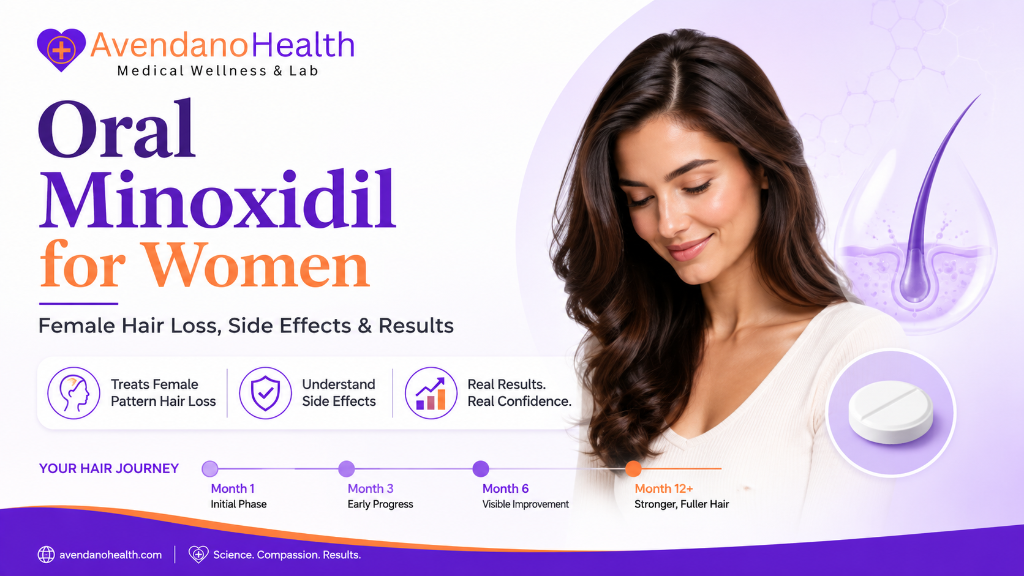
Female hair loss can affect confidence, hairstyling, self-image and quality of life. Some women notice gradual widening of the center part, reduced ponytail thickness or increased scalp visibility. Others experience sudden diffuse shedding after illness, stress, childbirth, rapid weight loss or another medical change.
Oral minoxidil is increasingly prescribed off-label for selected women who have female-pattern hair loss or another nonscarring hair-loss condition. It may be considered when topical minoxidil causes irritation, leaves unwanted residue or is difficult to use consistently.
However, oral minoxidil circulates throughout the body. It may affect blood pressure, heart rate, fluid balance and hair growth outside the scalp. It also requires particular caution regarding pregnancy and breastfeeding.
Avendano Health offers Lush Lox, a provider-reviewed female hair-growth option containing minoxidil 2.5 mg in an orally disintegrating tablet.
Review Lush Lox, current pricing and all available hair-growth options.
Oral minoxidil for women at a glance
| Question | Key point | | ------------------------ | ---------------------------------------------------------- | | Avendano Health option | Lush Lox | | Listed ingredient | Minoxidil 2.5 mg ODT | | Listed price | $149 | | Monthly subscription | Not required | | FDA status for hair loss | Oral minoxidil is used off-label | | Typical response window | Early response may appear around four to six months | | Meaningful evaluation | Usually six to twelve months | | Common cosmetic concern | Increased facial or body hair | | Systemic concerns | Dizziness, swelling, palpitations and lower blood pressure | | Pregnancy | Generally avoided | | Provider review | Required before prescribing |
What is female-pattern hair loss?
Female-pattern hair loss typically produces gradual thinning across the central or upper scalp while often preserving the frontal hairline.
Common signs include:
- A widening center part
- Reduced density over the crown
- More visible scalp under bright light
- A smaller ponytail circumference
- Shorter or finer hairs in thinning areas
- Gradual progression over months or years
Female-pattern hair loss differs from a completely smooth bald patch. Follicles remain present but may gradually produce thinner, shorter and less visible strands.
An expert task force described two common presentations: diffuse central thinning and a frontal-accentuation pattern sometimes called a "Christmas tree" pattern. Diagnosis is primarily clinical, although other causes of shedding must sometimes be investigated. (PubMed)
How does oral minoxidil work?
Minoxidil was originally developed as an oral medication for severe hypertension.
Its precise hair-growth mechanism remains incompletely understood, but it appears to influence follicle signaling and the natural hair cycle. Proposed effects include:
- Supporting the active anagen growth phase
- Helping resting follicles begin a new growth cycle
- Increasing hair-shaft diameter
- Supporting miniaturized but still-active follicles
- Improving visible scalp density in responsive patients
Oral minoxidil does not directly correct iron deficiency, thyroid disease, hormonal disorders or autoimmune hair loss. It also does not establish the underlying diagnosis by itself.
Low-dose oral minoxidil is increasingly used off-label, but expert panels continue to emphasize the need for appropriate patient selection, baseline assessment, monitoring and better long-term research. (PubMed)
Is oral minoxidil FDA-approved for female hair loss?
No.
Oral minoxidil is FDA-approved for severe hypertension, not hair loss. Its use for female-pattern thinning is off-label.
Topical minoxidil has an established FDA-approved role in pattern hair loss. Oral treatment may still be prescribed when a licensed clinician determines that the potential benefits justify the systemic risks.
Off-label prescribing does not automatically mean a treatment is ineffective or unsafe. It means the FDA has not approved that particular medication, dose and route for that particular condition.
Is 2.5 mg a common dose for women?
Women are often started on lower doses of oral minoxidil, with the dose adjusted according to response and tolerability.
A 2026 international consensus focused on pattern hair loss recommended adult female starting doses around 0.625 to 1.25 mg daily, with 2.5 mg daily as a maximum dose in that guidance. These recommendations were consensus-based and should not replace individualized prescribing. (PubMed)
That distinction matters for Lush Lox:
- Lush Lox contains minoxidil 2.5 mg.
- That amount may not be the appropriate starting dose for every woman.
- A provider must review blood pressure, medical history, medications and individual risk.
- Completing the consultation does not guarantee approval.
The formulation is also an orally disintegrating compounded tablet. Evidence involving standard swallowed minoxidil tablets should not automatically be treated as identical evidence for every compounded ODT formulation.
What does the research show in women?
Research is encouraging, but the studies vary significantly in dose, design and quality.
A randomized trial involving 72 women compared oral minoxidil 0.25 mg with topical minoxidil 2% over nine months. Both groups experienced significant improvements in hair density and diameter, with no statistically significant difference between the treatments. The oral dose was much lower than 2.5 mg. (PubMed)
A small retrospective study of 12 women used an initial oral dose of 0.5 mg, later increased to 1.5–2 mg. After 24 weeks, investigators reported significant improvement in frontal hair density, but the study's very small size and retrospective design limit certainty. (PubMed)
A separate retrospective study of 105 adults—76% of whom were women—used doses from 0.625 to 2.5 mg for at least 52 weeks. Approximately 52% improved and 43% stabilized. Because the population included both androgenetic alopecia and telogen effluvium, the result does not provide a precise success rate for female-pattern hair loss alone. (PubMed)
The practical conclusion is:
Oral minoxidil may help selected women, but the evidence does not establish that every woman needs 2.5 mg or that one dose is best for everyone.
Oral minoxidil results timeline for women
Hair grows slowly. Results should be measured over months rather than days.
Month 1: Usually too early for visible improvement
During the first few weeks, most women should not expect obvious regrowth.
Possible experiences include:
- No visible change
- Continued baseline shedding
- Temporary increased shedding
- Mild dizziness
- Headache
- Faster heartbeat
- Fluid retention
- Early unwanted facial or body hair
The medication may already be influencing follicles, but new hair takes time to emerge above the scalp.
This period is more useful for evaluating tolerability than effectiveness.
Months 1–3: Initial shedding may occur
Minoxidil may shift resting follicles toward a new active growth cycle.
Older resting hairs may fall before replacement growth becomes visible. This is often called the "minoxidil shed."
Temporary shedding:
- Does not affect everyone
- Is not required for treatment to work
- Does not automatically mean the condition is worsening
- Should generally improve rather than continue indefinitely
Sudden severe shedding should not automatically be attributed to the medication. Iron deficiency, thyroid disease, recent illness, major weight loss, childbirth, medications and severe stress can also trigger diffuse shedding.
Contact the provider when shedding is:
- Severe or rapidly worsening
- Patchy rather than diffuse
- Associated with pain, itching or inflammation
- Accompanied by scarring
- Continuing without improvement
- Associated with other medical symptoms
Months 3–6: Early results may become visible
By months three through six, some women may notice:
- Less hair falling in the shower
- Reduced shedding while brushing
- Short new hairs along the part
- Improved crown coverage
- Slightly thicker-looking strands
- A more stable ponytail circumference
- No obvious improvement yet
Recent consensus guidance suggests that a clinical response may become apparent around four to six months. (PubMed)
No visible change at month three does not necessarily mean treatment has failed.
Months 6–12: The meaningful evaluation period
A clearer assessment usually requires six to twelve months.
The patient and provider can evaluate:
- Hair density
- Hair-shaft thickness
- Width of the center part
- Scalp visibility
- Changes in standardized photographs
- Daily shedding
- Side effects
- Whether the benefit justifies continued treatment
A successful result may involve visible thickening, but stabilization can also matter.
Female-pattern thinning is usually progressive. Slowing continued loss may be valuable even when dramatic regrowth does not occur.
Can oral minoxidil cause facial hair in women?
Yes.
Increased facial or body hair is called hypertrichosis. It is the most common adverse effect associated with low-dose oral minoxidil.
A large retrospective study of 1,404 patients—approximately two-thirds of whom were women—reported hypertrichosis in 15.1%. Only 0.5% stopped treatment because of it. The study included multiple doses and hair-loss conditions, so 15.1% is not a precise risk estimate for women taking 2.5 mg. (PubMed)
A 2026 survey of 102 women with female-pattern hair loss found that 71.6% reported unwanted hair growth, commonly involving the face, arms or legs. Most described it as mild or moderate, and 93.2% did not consider it a reason to stop treatment. The higher percentage may reflect direct patient questioning rather than adverse effects recorded in medical charts. (PubMed)
This difference shows why no single percentage should be presented as the guaranteed risk.
Possible areas include:
- Upper lip
- Chin
- Sideburn area
- Cheeks
- Arms
- Legs
- Back
- Abdomen
Is unwanted facial hair dose-dependent?
Evidence suggests hypertrichosis becomes more likely as the dose increases.
A pooled analysis of 14 studies found higher odds of excessive hair growth at larger oral-minoxidil doses. Women may also report this side effect more frequently or find it more cosmetically disruptive. (PubMed)
Management options may include:
- Waxing
- Threading
- Shaving
- Depilatory products
- Laser hair reduction
- Dose modification
- Switching treatments
- Discontinuation when unacceptable
Patients should not split or reduce a compounded tablet without the prescriber's approval.
What blood-pressure effects are possible?
Oral minoxidil is a systemic vasodilator. It relaxes blood vessels and was originally developed to lower blood pressure.
Possible symptoms include:
- Lightheadedness
- Dizziness when standing
- Weakness
- Headache
- Faster heartbeat
- Palpitations
- Lower blood-pressure readings
- Feeling faint
In the 1,404-patient retrospective study, systemic effects included lightheadedness in 1.7%, fluid retention in 1.3%, tachycardia in 0.9%, headache in 0.4% and swelling around the eyes in 0.3%. These figures covered several doses and are not specific to women taking 2.5 mg. (PubMed)
The FDA-approved oral-minoxidil label also contains serious cardiovascular warnings from its hypertension use, including fluid retention, increased heart rate and pericardial effusion. Those warnings do not quantify the risk at low hair-loss doses, but they explain why provider screening is necessary. (DailyMed)
Can oral minoxidil cause swelling?
Yes.
Minoxidil can cause fluid retention, which may appear as:
- Ankle swelling
- Tight shoes
- Puffy eyelids
- Facial swelling
- Rapid weight increase
- Generalized bloating
Mild swelling still deserves discussion with the prescriber. Significant swelling, shortness of breath or rapid weight gain requires prompt medical evaluation.
Who may need additional caution?
A provider may need more information or specialist input when a woman has:
- Low blood pressure
- Frequent dizziness or fainting
- Heart-rhythm problems
- Palpitations
- Heart failure
- Previous pericardial disease
- Significant fluid retention
- Kidney disease
- Liver disease
- Multiple blood-pressure medications
- Medications that affect heart rate
- Pregnancy or pregnancy plans
- Breastfeeding
- Unexplained sudden hair loss
The 2025 international consensus addressed contraindications, precautions, baseline assessment, monitoring and circumstances in which specialty consultation may be appropriate. (PubMed)
What may be reviewed before prescribing?
A provider may review:
- Hair-loss pattern
- Current blood pressure
- Resting pulse
- Cardiovascular history
- Kidney history
- History of swelling
- Current prescriptions
- Supplements and over-the-counter products
- Pregnancy status and plans
- Menstrual history
- Recent childbirth
- Major illness
- Rapid weight change
- Symptoms suggesting iron or thyroid problems
- Signs of androgen excess
Not every patient needs every laboratory test, electrocardiogram or specialist referral. The workup should match the patient's symptoms and risk factors.
Pregnancy precautions
Oral minoxidil is generally avoided during pregnancy.
The official minoxidil label states that adequate controlled studies in pregnant women are unavailable. Animal studies identified developmental concerns at certain exposures, and neonatal hypertrichosis has been reported after minoxidil exposure during pregnancy. (DailyMed)
A 2026 consensus regarding minoxidil and pattern hair loss recommended avoiding minoxidil during pregnancy and breastfeeding. (PubMed)
Women should tell the provider if they:
- Are pregnant
- May be pregnant
- Are actively trying to conceive
- Plan pregnancy soon
- Are not using reliable contraception when pregnancy is possible
Do not wait until a positive pregnancy test to discuss reproductive plans.
A woman who becomes pregnant while taking oral minoxidil should contact the prescriber promptly rather than making assumptions based on online information.
Breastfeeding precautions
Information about oral minoxidil during breastfeeding remains limited.
The prescribing information reports minoxidil excretion into breast milk following oral use and warns about potential effects on nursing infants. (DailyMed)
The 2026 LactMed review advises caution with oral minoxidil, particularly with larger maternal doses or when breastfeeding a newborn. (PubMed)
Because Lush Lox is an elective hair-loss treatment rather than treatment for a life-threatening condition, oral minoxidil is generally not the first choice during breastfeeding without specialist guidance.
When can laboratory testing help?
Female-pattern hair loss is usually diagnosed clinically, but lab evaluation can help when symptoms suggest another contributing condition.
A multidisciplinary task force recommends assessing for possible androgen excess and states that testing for iron, vitamin D, zinc, thyroid hormones and prolactin may also be considered. (PubMed)
Testing may be particularly useful when a woman has:
- Heavy menstrual bleeding
- Fatigue
- Shortness of breath
- Restrictive dieting
- Major recent weight loss
- Irregular or absent periods
- New acne
- Increased facial hair
- Fertility concerns
- Symptoms of thyroid disease
- Recent pregnancy
- Sudden diffuse shedding
- A family or personal history of anemia
- Hair loss that does not match a typical female pattern
Possible tests based on symptoms
A clinician may consider:
Complete blood count
A CBC can help identify anemia or other blood-cell abnormalities.
Ferritin and iron studies
Ferritin reflects stored iron. Iron deficiency can contribute to diffuse shedding, especially in women with heavy menstrual bleeding or restrictive diets.
A study of women with female-pattern hair loss or chronic telogen effluvium found lower average ferritin levels than in controls, although the exact ferritin threshold required for optimal hair growth remains debated. (PubMed)
Thyroid-stimulating hormone
Thyroid disorders can contribute to diffuse hair changes, fatigue, temperature intolerance and weight changes.
Vitamin D
Low vitamin D is common and has been observed in some hair-loss populations, although correcting a deficiency does not guarantee hair regrowth.
Zinc
Zinc testing may be considered when deficiency is plausible based on diet, gastrointestinal disease or other symptoms.
Prolactin
Prolactin may be evaluated when menstrual or hormonal symptoms suggest it could be relevant.
Androgen evaluation
When there are signs of androgen excess, testing may include:
- Total testosterone
- Free testosterone or an appropriate calculated measure
- DHEA-S
- Other tests selected by the clinician
Signs that may justify a hormonal evaluation include:
- Irregular periods
- New or severe acne
- Increased coarse facial hair
- Infertility
- Rapidly progressing scalp thinning
- Virilizing symptoms
Testing should be directed by clinical findings rather than ordering every available hormone panel for every woman.
Does correcting a deficiency replace minoxidil?
Not always.
When iron, thyroid, vitamin or hormonal abnormalities contribute to shedding, correcting the underlying condition may be an essential part of treatment.
However, a woman can have both:
- Female-pattern hair loss
- A separate contributor such as iron deficiency or telogen effluvium
Treating one does not automatically correct the other.
That is why the most useful plan may combine:
- Diagnosis of the hair-loss pattern
- Appropriate laboratory investigation
- Correction of identified abnormalities
- A provider-selected hair-growth treatment
- Long-term photographic monitoring
What is Lush Lox?
Lush Lox is Avendano Health's female hair-growth option.
The current offering contains:
- Minoxidil 2.5 mg ODT
Current listed price: $149
It is designed as a simple daily oral option for selected women who may benefit from systemic minoxidil and prefer not to use a topical product.
Potential convenience advantages include:
- No liquid scalp application
- No greasy residue
- No drying time
- Less interference with hairstyling
- A simple daily routine
- No mandatory monthly subscription
Convenience does not establish medical eligibility. The listed 2.5 mg dose represents the upper female dose in one recent consensus, making individual provider review especially important. (PubMed)
View Lush Lox and begin the online hair consultation.
Who may be considered for Lush Lox?
A provider may consider Lush Lox for an adult woman who:
- Has female-pattern hair loss or another appropriate nonscarring condition
- Has difficulty tolerating topical minoxidil
- Finds topical treatment difficult to use consistently
- Understands the risk of facial or body hair
- Has completed cardiovascular and medication screening
- Is not pregnant or breastfeeding
- Has realistic six-to-twelve-month expectations
- Can follow provider monitoring instructions
It may not be appropriate when:
- Pregnancy is possible or planned
- The patient is breastfeeding
- Blood pressure is already very low
- There is significant cardiovascular disease
- Fluid retention is a major concern
- Hair loss appears inflammatory or scarring
- Hair loss is sudden or patchy
- The diagnosis has not been clarified
- The patient expects immediate or guaranteed regrowth
How should progress be measured?
Photographs are more reliable than daily mirror checks.
Take standardized pictures at:
- Baseline
- Month one
- Month three
- Month six
- Month nine
- Month twelve
Keep consistent:
- Lighting
- Camera
- Distance
- Hair length
- Hairstyle
- Whether the hair is wet or dry
- Front, center-part, temple, top and crown views
Women may also track:
- Center-part width
- Ponytail circumference
- Daily shedding
- Medication consistency
- Facial or body hair
- Dizziness
- Swelling
- Palpitations
- Blood-pressure readings when instructed
- Menstrual or hormonal changes
When should a patient contact the provider?
Contact the prescribing clinician for:
- Significant unwanted facial hair
- Persistent dizziness
- Recurrent palpitations
- Ankle or facial swelling
- Rapid weight gain
- Severe headache
- Prolonged or worsening shedding
- Pregnancy or pregnancy plans
- Any new medication
- A blood-pressure change outside the provider's instructions
Seek prompt or urgent care for:
- Chest pain
- Fainting
- Severe shortness of breath
- Rapid or irregular heartbeat
- Major swelling
- Difficulty breathing while lying down
- Severe allergic swelling or rash
Is Lush Lox FDA-approved?
No.
Oral minoxidil is not FDA-approved for hair loss.
Lush Lox is a compounded orally disintegrating formulation and is not individually FDA-approved.
Compounded medications are not reviewed before marketing for safety, effectiveness and quality in the same way as FDA-approved drug products. The prescribing provider must determine whether a compounded option is appropriate for the individual patient.
Frequently asked questions
Does oral minoxidil work for women?
Clinical studies suggest that low-dose oral minoxidil may improve or stabilize hair loss in selected women, but responses vary and larger long-term trials remain limited. (PubMed)
How long does oral minoxidil take to work?
Early response may appear around four to six months. A clearer assessment generally requires six to twelve months. (PubMed)
Will oral minoxidil cause facial hair?
It can. Facial or body hair is the most commonly reported cosmetic side effect, but severity varies substantially. (PubMed)
Does every woman experience initial shedding?
No. Temporary shedding is possible but is not required for treatment to work.
Is 2.5 mg too high for a woman?
It is not automatically too high, but a 2026 consensus listed 2.5 mg as the maximum adult female dose rather than the usual starting dose. Eligibility requires individualized provider review. (PubMed)
Can oral minoxidil lower blood pressure?
Yes. It is a systemic vasodilator and may cause dizziness, lower blood pressure, faster heart rate or fluid retention.
Can oral minoxidil be used during pregnancy?
It is generally avoided during pregnancy. Women who are pregnant, may be pregnant or are trying to conceive should disclose this before treatment. (DailyMed)
Can it be used while breastfeeding?
Oral minoxidil is generally avoided or used only with specialist guidance because lactation data are limited and minoxidil can enter breast milk. (PubMed)
Do I need blood tests before taking it?
Not every woman needs the same tests. Lab evaluation may help when there is sudden shedding, heavy periods, fatigue, restrictive dieting, hormonal symptoms or another reason to suspect an underlying contributor.
Does Lush Lox contain finasteride?
No. The current listed ingredient is minoxidil 2.5 mg ODT.
Is a monthly subscription required?
No monthly subscription is required.
Is prescription approval guaranteed?
No. A licensed provider reviews the patient's medical information and determines whether treatment is appropriate.
Explore Lush Lox
Lush Lox — $149
Current listed ingredient:
- Minoxidil 2.5 mg ODT
Lush Lox is designed to support healthier, fuller-looking hair through a provider-supervised daily oral routine.
Treatment requires medical review, and approval is not guaranteed.
View Lush Lox and Start Your Hair Consultation
This article is educational and does not replace medical advice, diagnosis or treatment from a licensed healthcare professional.
References
-
Akiska YM, et al. Low-Dose Oral Minoxidil Initiation for Patients With Hair Loss: An International Modified Delphi Consensus Statement. JAMA Dermatology. PMID: 39565602.
-
Vahabi-Amlashi S, et al. Randomized clinical trial of oral minoxidil in female-pattern hair loss. PMID: 34529341.
-
Vastarella M, et al. Efficacy and safety of oral minoxidil in female androgenetic alopecia. PMID: 32851744.
-
Feaster B, et al. Oral minoxidil use in androgenetic alopecia and telogen effluvium. PMID: 35244759.
-
Vañó-Galván S, et al. Safety of low-dose oral minoxidil for hair loss in 1,404 patients. PMID: 33639244.
-
Sharma D, et al. Quality of life and patient-reported side effects of low-dose oral minoxidil in female-pattern hair loss. PMID: 41741964.
-
Carmina E, et al. Female Pattern Hair Loss and Androgen Excess: Multidisciplinary Committee Report. PMID: 30785992.
-
Minoxidil tablets. Current U.S. prescribing information. DailyMed.