
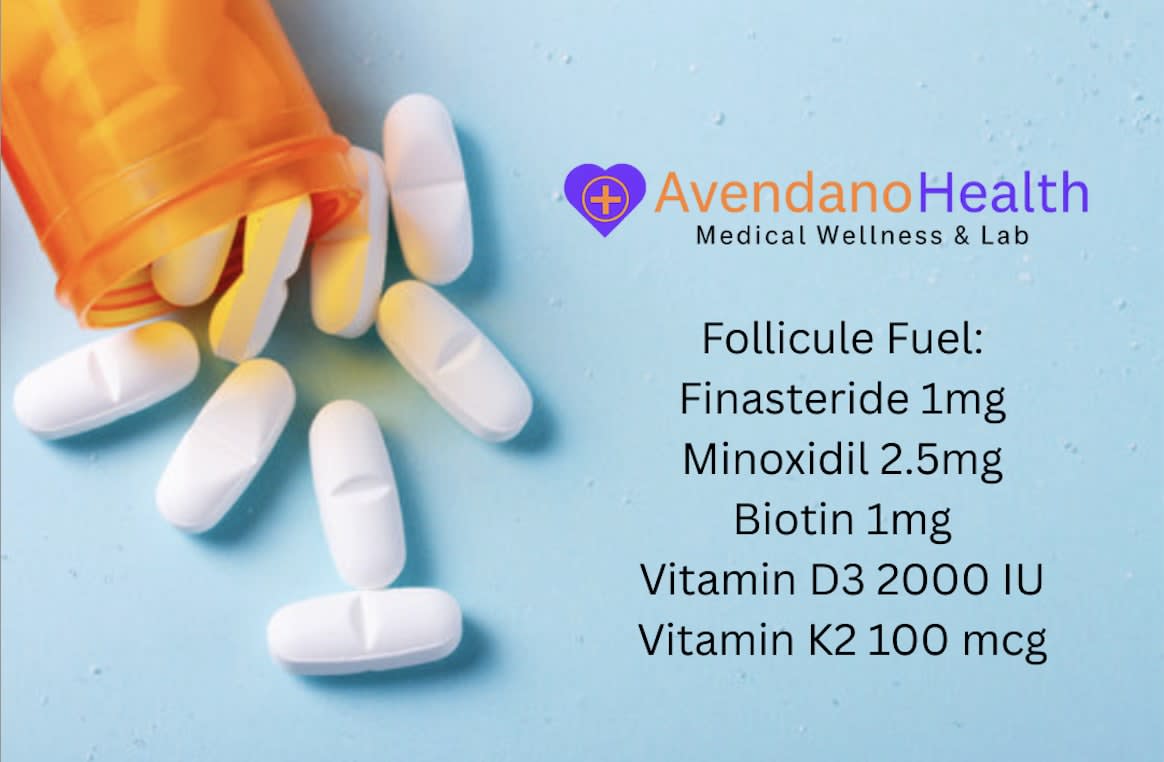
Topical vs. Oral Hair Loss Medications: Pros, Cons, and the Lab Considerations That Should Guide Your Choice
The decision between topical and oral formulations for hair loss treatment is not primarily a question of which is more effective in the abstract — it is a question of which is more effective for your specific hair loss pattern, your lifestyle, your systemic health baseline, and your adherence profile. At Avendano Health, our CLIA-certified lab in Boca Raton (Facility ID: #10D2328758) provides the baseline bloodwork that makes this a data-driven clinical decision rather than a guess. Transparent Cash-Pay Pricing. No Insurance Required. No Hidden Fees.
Start with a baseline lab panel before choosing your treatment approach. View our lab menu here.
The Landscape — What You Are Actually Choosing Between
Hair loss pharmacotherapy for androgenetic alopecia involves two primary agents: minoxidil (a vasodilator and hair cycle modulator available in topical and oral formulations) and finasteride (a Type II 5-alpha reductase inhibitor available in oral form). These agents work through completely different mechanisms and are not interchangeable — they are complementary, targeting different biological points in the androgenetic alopecia process. The delivery format question (topical versus oral) applies primarily to minoxidil, as finasteride is currently used clinically only in oral form for hair loss.
Topical Minoxidil — The Mechanism and Clinical Profile
Topical minoxidil (available in 2% and 5% solutions and 5% foam formulations) is applied directly to the scalp, where it acts as a potassium channel opener that promotes vasodilation at the follicular level, increasing blood flow and nutrient delivery to the hair follicle. It also directly modulates the hair growth cycle, promoting anagen phase entry in follicles transitioning from telogen and prolonging the anagen phase once initiated. The sulfate ester of minoxidil — minoxidil sulfate — is the pharmacologically active form, converted from minoxidil by sulfotransferase enzymes expressed in hair follicle outer root sheath cells. Patients with low sulfotransferase activity — a genetic variation — show reduced topical minoxidil efficacy, which explains the variable response rate among consistent users.
Clinical advantages of topical minoxidil: Minimal systemic absorption at standard doses limits systemic side effects. Direct delivery to the target tissue — the scalp follicle — without requiring hepatic metabolism. Available over the counter in standard formulations.
Clinical limitations of topical minoxidil: Twice-daily application requirement significantly reduces real-world adherence compared to once-daily oral alternatives. Propylene glycol in solution formulations causes scalp irritation and contact dermatitis in a meaningful proportion of users (foam formulations reduce but do not eliminate this). Variable efficacy based on individual sulfotransferase activity. The application-dependent nature means that missed doses directly reduce therapeutic effect in a way that oral formulations with longer half-lives do not.
Oral Minoxidil — The Emerging Clinical Standard for Many Patients
Low-dose oral minoxidil (0.25mg to 1.25mg daily for hair loss — well below the 5 to 40mg doses used for hypertension) has emerged as a clinically significant alternative to topical application for several reasons. Oral dosing achieves systemic distribution to all follicular units simultaneously, eliminating the application technique variability and scalp irritation issues of topical formulations. The lower adherence burden of a single daily pill versus twice-daily topical application produces meaningfully better real-world compliance in clinical practice.
Efficacy data for low-dose oral minoxidil is comparable to or exceeding topical 5% in head-to-head studies. The primary side effect concern is dose-dependent fluid retention and, at higher doses, hypertrichosis (increased body and facial hair growth). At the 0.25mg to 1.25mg doses used for hair loss, these effects are generally minimal but warrant baseline assessment. A CBC and basic metabolic panel from our General Lab Work menu provides the safety baseline appropriate before starting oral minoxidil, particularly for patients with any cardiovascular history.
Oral Finasteride — The DHT Mechanism and Safety Considerations
Finasteride 1mg daily is the primary pharmacological intervention targeting the DHT-driven mechanism of androgenetic alopecia. It inhibits Type II 5-alpha reductase, reducing scalp DHT levels by approximately 60 to 70 percent and thereby removing the primary biological signal driving follicular miniaturization in susceptible patients.
Finasteride is absorbed orally, metabolized hepatically, and achieves steady-state DHT suppression within one to two weeks. Its mechanism is systemic — it affects DHT throughout the body, not just at the scalp. This systemic DHT reduction is the basis for the sexual side effects (reduced libido, erectile dysfunction, ejaculation changes) reported in approximately 1 to 3 percent of users in clinical trials. The majority of patients experiencing these effects see resolution upon discontinuation, and in most patients, finasteride is well-tolerated over long-term use.
Baseline hormonal labs — Total and Free Testosterone, estradiol — from our Men's Comprehensive Hormone Bundle ($249) provide the clinical context for finasteride candidacy and allow monitoring during therapy for any patients with side effect concerns.
The Lab Considerations That Should Guide Your Treatment Choice
Before selecting any hair loss treatment approach, baseline bloodwork resolves two critical questions. First: is the hair loss actually androgenetic, or is there a correctable underlying cause (hypothyroidism, iron deficiency, vitamin D deficiency) that should be addressed before pharmacotherapy? Second: what is your hormonal baseline, and are there existing conditions that inform treatment selection?
The recommended pre-treatment panel from our General Lab Work menu:
- TSH ($28): Rules out hypothyroidism as the primary hair loss driver.
- Ferritin: Iron stores below 40 ng/mL drive telogen effluvium that blunts response to androgenetic alopecia treatment.
- Vitamin D ($50): Deficiency impairs follicular cycling and is common across South Florida patients.
- Total Testosterone ($45) and Free Testosterone ($85): Hormonal baseline and DHT substrate context. Essential before initiating finasteride.
- CBC ($25): Safety baseline, particularly relevant before oral minoxidil.
Frequently Asked Questions
Which is more effective — topical or oral minoxidil?
Clinical studies suggest low-dose oral minoxidil produces equivalent or superior hair count outcomes compared to topical 5% in head-to-head data, largely because real-world adherence to a once-daily pill significantly exceeds adherence to twice-daily topical application. For patients with scalp irritation from topical formulations, oral minoxidil is the clinically preferred alternative.
Can I use topical and oral minoxidil simultaneously?
This combination is not standard practice and is generally not recommended, as it adds systemic exposure without proportional clinical benefit. The choice between topical and oral should be made based on your adherence profile and tolerability, not combined.
Do I need a prescription for oral minoxidil?
Yes. Oral minoxidil at any dose requires a prescription. Topical minoxidil at 2% and 5% is available over the counter. Our telehealth team can prescribe oral minoxidil following a clinical evaluation. Visit our Men's Health page for details.
How long before I see results from either formulation?
Both topical and oral minoxidil typically produce the first visible density improvement at six to twelve months of consistent use, following an initial shedding phase at weeks six to twelve. Finasteride's stabilization effect is measurable at six months; regrowth is assessed at twelve months. Combination therapy produces results faster than either agent alone in most patients.